
Research travels the world
Colleague from Feuchtwangen at conferences in the USA and Australia
Last month, research assistant Regina Weger, M. Eng., had the special opportunity to present the work of the Feuchtwangen campus at two major international conferences – in Denver (USA) and Brisbane (Australia). Both events are important meeting places for experts involved in energy efficiency, sustainability, and the construction of the future.
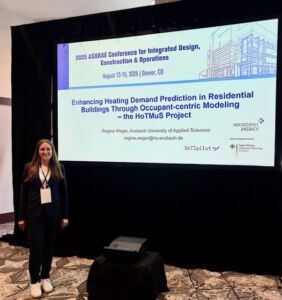
At the ASHRAE Conference for Integrated Design, Construction & Operations (CIDCO) in Denver, Colorado, she presented the HoTMuS project – a DATIpilot project funded by the BMFTR. It addresses the question of how residents’ behavior affects heating energy requirements. Even the most modern technology can only work as efficiently as it is used in everyday life. Using the example of a tiny house community, the study shows which behaviors have a particular impact on energy consumption and how better forecasts can be used to tap into potential savings. “It was exciting to see how much interest there is in the topic of user behavior. Many colleagues from a wide range of countries reported that they face similar challenges in their work,” says Regina Weger.
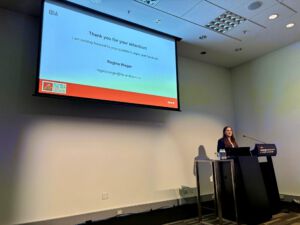
Just one week later, the journey continued to Brisbane for Building Simulation 2025. There, the employee presented a study on automatic window ventilation—a technology that can help cool buildings naturally in summer, thereby reducing the use of energy-intensive air conditioning systems. The research is based on the new teaching building on the Feuchtwangen campus, which serves as a real-world laboratory. Here, the concept can not only be simulated, but also tested directly under real conditions. Initial results show that overheating can be significantly reduced through automated night ventilation, effective shading, and the use of storage masses, and that with very little energy consumption. It is particularly gratifying that this work was not only presented in Brisbane, but also published in a scientific paper. “It was a special feeling to present the results from Feuchtwangen on an international stage,” reports our colleague.
An essential part of both conferences was international exchange. This led to discussions with experts from Canada, France, and the US, which opened up new perspectives and provided valuable impetus for future projects. These contacts contribute to sharing experiences and initiating possible collaborations.
It also became clear that the topic of artificial intelligence (AI) is playing an increasingly important role. Whether in predicting user behavior or controlling ventilation systems, AI will be crucial in the coming years and also opens up many new opportunities for our research.
With the many impressions, contacts, and new ideas from Denver and Brisbane, our colleague is bringing back valuable inspiration that will be incorporated into current and future projects. The contributions on both continents impressively demonstrate that our research is also gaining international recognition.
Upcoming dates:
September 27 to 28:
Visit the Feuchtwangen campus of Ansbach University of Applied Sciences with an information stand at the Mooswiesenausstellung exhibition! Whether you are curious, interested in the subject, or just feeling spontaneous – come and see us!
October 9:
Together with Ansbach University of Applied Sciences, you will find the Feuchtwangen campus at the Orientation Fair for Education & Careers in the casino/foyer of the Bavarian Construction Academy. There, too, we will be happy to answer any questions you may have about studying, campus life, and career opportunities.
Tip for anyone interested: Our campus building is located in the immediate vicinity of the orientation fair – it’s worth a spontaneous visit! We will be happy to take the time for a short tour and a personal chat on this day – even without prior registration.
We look forward to seeing you there!